
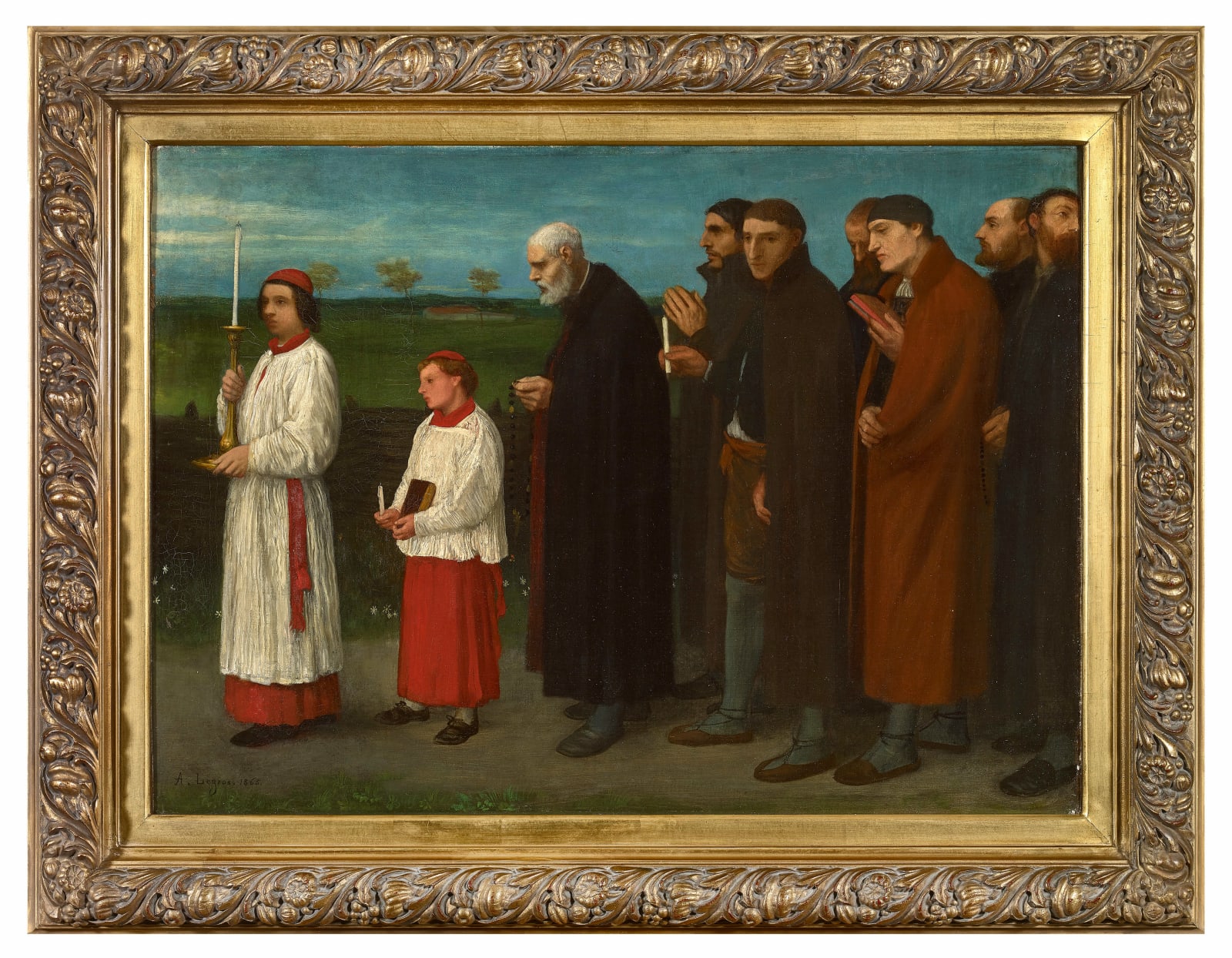

Alphonse Legros
LA PROCESSION, 1865
oil on canvas
20 by 27 in.
50.8 by 68.6 cm.
50.8 by 68.6 cm.
Further images


The Procession is part of a series of religious genre compositions that Alphonse Legros painted in the 1860s. He first received wide-spread critical acclaim for such a subject, when in 1859, he exhibited The Angelus (sold by Gallery 19C in 2018) at the 1859 Salon. This work, which was greatly admired by Charles Baudelaire, was followed by such well-known paintings as L’Ex-Voto, 1860 (Dijon, Musée des Beaux Arts) and La Vocation de St. François, 1861 (Musées d’Alencon).
Paintings representing scenes of great piety formed a significant part of the repertoire of many French Realist artists of the time; one thinks specifically of François Bonvin, Isidore Pils, Pascal Adolphe Jean Dagnan-Bouveret, Théodule Ribot and Jules Breton. La Plantation d’un Calvaire (Lille, Musée des Beaux Arts), Breton’s entry to the 1859 Salon (the same Salon that included Legros’ L’Angelus), depicted a monumental, multi-figural composition of a sacred village procession, but perhaps the most well-known treatment of the subject was Gustave Courbet’s The Burial at Ornans painted between 1849-50 (Paris, Musée d’Orsay). Most likely, Legros was aware of both works, but the greater influence came from Courbet, especially when we compare the overlapping “silhouette” arrangement of the figures in each picture.
Legros’s painting depicts two young altar boys leading a procession of village clergy, or perhaps monks from a local monastery. According to the art critic, Philippe Burty, Legros would often visit a monastery in Paris to observe the daily rituals of the inhabitants (see Gabriel Weisberg, The Realist Tradition, French Painting and Drawing, 1830-1900, Cleveland, 1981, p. 116). Similar to Courbet’s Burial, Legros’ painting shows a lack of anecdote. But unlike Courbet’s painting, we do not know the subject; is it a funeral procession or the celebration of a feast day? There is no indication as to the occasion; Legros’ emphasis is on the solemnity of the scene as expressed by the faces of the worshippers, and which is underscored by his use of a predominantly somber, tonal palette. As in his Angelus, Legros has succeeded in showing the piety of each individual as an inward and personal expression of their faith.