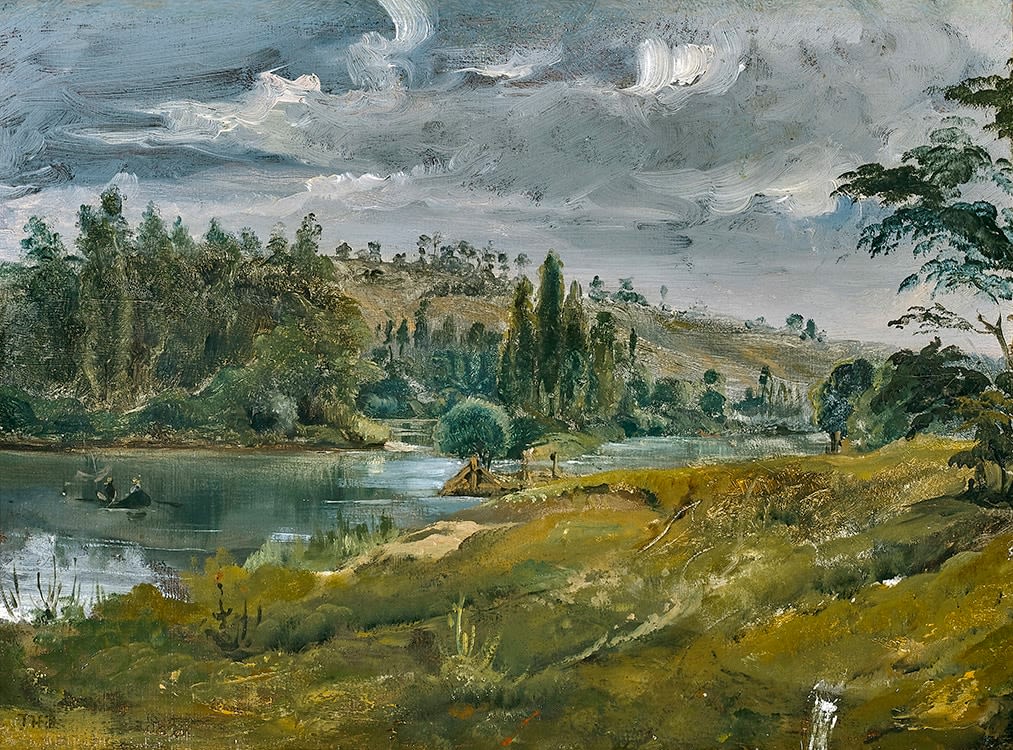
Théodore Rousseau
LA VALLÉE TOURNANTE DE THIÉZAC, AUVERGNE
oil on paper laid down on canvas
9 5/8 by 12 3/4 in.
24.4 by 32.4 cm.
24.4 by 32.4 cm.
Théodore Rousseau is the master. ...The king of landscape painting. —Jules-Antoine Castagnary, “Salon de 1859,”in Castagnary,Salons (1857-1870), vol. I, Paris, 1892, p. 81Théodore Rousseau’s influence on the development of modern landscapepainting and leading rolein the École de Barbizonmovementis universally recognized.His work in the Forest ofFontainebleau, one of Rousseau’s most revered achievements, originated from a six-month sketching career-defining trip he took in 1830 in the Auvergne region in central France, afterfailingto win the Prix de Romeand its accompanying scholarship, which would have enabled him to live inItaly. Rousseau was so enthused by the turbulent spectacle ofnatureand the austere beauty of the scenery set amongvolcanic mountains of Auvergne that he devoted himself to depicting native French sitesfor the rest of his career. In Auvergne, not only did Rousseau develop new motifs, he also found the inspiration that made him one of France’s most important and innovative landscape painters.Rousseau’s romantic feeling of the sublime is particularly epitomizedin the execution, composition and coloringof thepaintingat hand, La vallée tournante de Thiézac. This evocative landscapeechoes the power of observation seen in John Constable in England a generation earlierand theplein-air tradition initiated byPierre-Henri de Valenciennes and Camille Corot.Rousseau’s luscious effect and attention to atmospheric effects attain their luminosity from layers of translucent green and brown glazes with sinuous strokes. Simultaneously exploringan enclosed and panoramic landscape, Rousseau draws the observer’s eye to themeandering river, whoseinherentpower dug the valley of Thiézac. The river is the central protagonist of the painting, dividingthe composition in half, whilereflections of the rich and contrasting lightblend the surroundingforms of nature—the stormy sky, the distant trees and the water—intoa mystical whole. The remarkable worksRousseau produced in Auvergne attractedthe attention of celebratedpainter Ary Scheffer (1795–1858), who exhibitedthem in his Paris studio, helping to launch Rousseau’s career. By1831, Rousseaubeganexhibiting at the Salon, and within three years, he acquired both a prestigious patron, the duc d’Orléans, and a medal from the Salon.
Provenance
Alfred Sensier, Paris (his sale, Hôtel Drouot, Paris, December11-12, 1877, lot 96)Jules Porgès, Paris
Edward Fowles, USA
Thence by descent, Jean Fowles, USA
Sale: Sotheby’s, New York, February29, 1984, lot 106Claude Aubry, Paris
Giuseppe Gavazzeni (by 2008)
Sale: Christie’s, London, July 13, 2017, lot 76
Literature
M. Schulman, Théodore Rousseau, catalogue raisonné de l’œuvre peint, Paris, 1999, p. 110, no. 81 (illustrated in color)Théodore Rousseau, The Language of Nature, Salander-O’Reilly Galleries, New York, 2002, p. 26
Gustave Courbet e il suo tempo, Verona, 2008, p. 225, no. 62 (illustrated, p. 129)