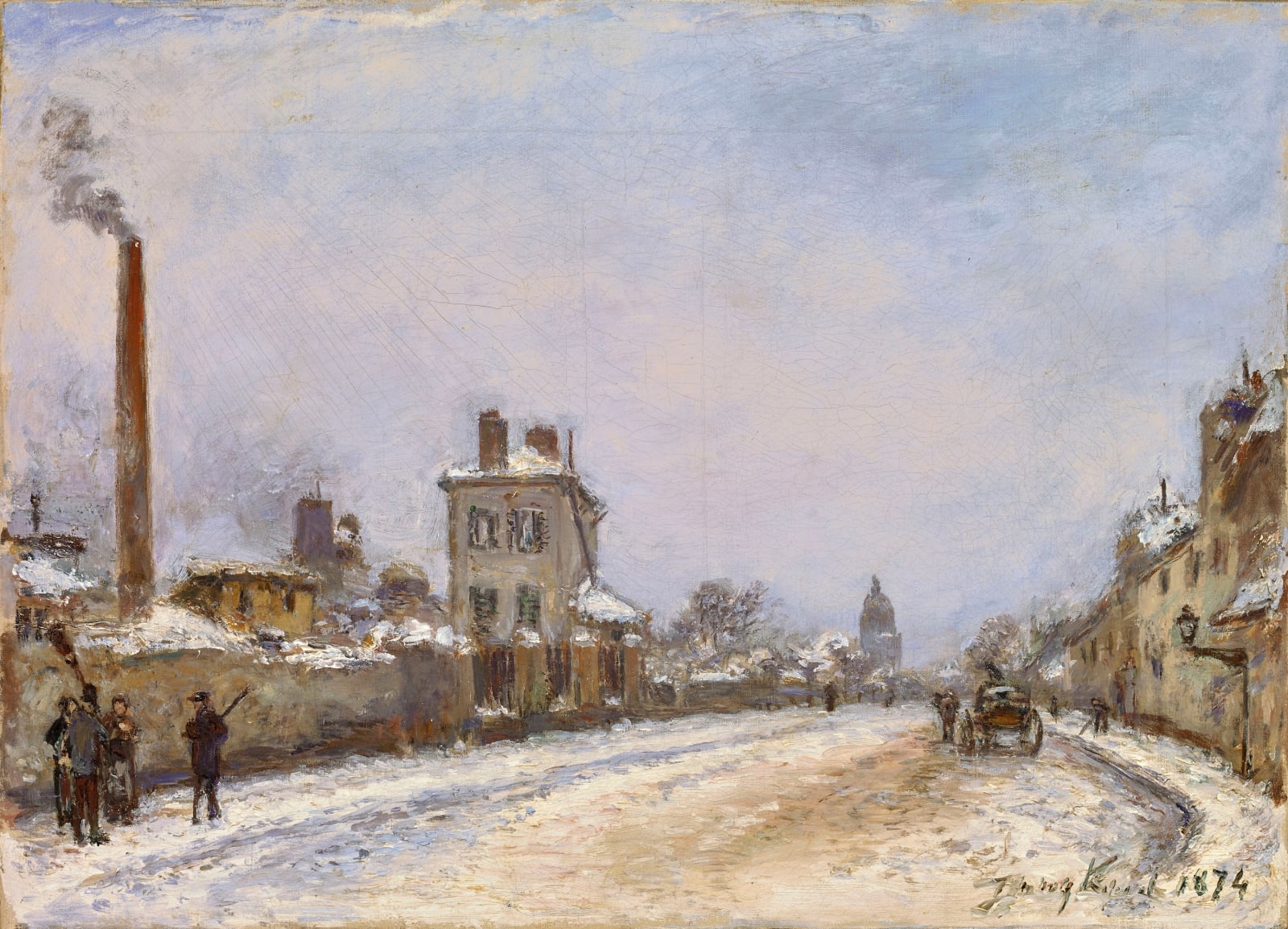
Johan Barthold Jongkind
STREET SCENE IN PARIS IN WINTER: RUE NOTRE-DAME-DES-CHAMPS
oil on canvas
13 by 18 in.
33 by 45.7 cm.
33 by 45.7 cm.
“This deep love of modern Paris, I found it in Jongkind …”
- Émile Zola
Arriving in Paris in 1844, a decade before the dramatic changes initiated by Baron Georges-Eugène Haussmann (1809-1891) had begun, and wintering in the city long after the boulevards and gaslights had been created and installed, Johan Jongkind witnessed a landscape in a state of rapid flux and motion. The pictures that he produced during these historic years reveal the work of Paris’s urban transformation and the changing fabric of the city, through a variety of atmospheric conditions and formal effects. In Street Scene in Paris in Winter, Jongkind presents a panoramic view of a well-known site in the 6th arrondissement, the Rue Notre-Dame-des-Champs. Far from a topographical portrait, however, Jongkind’s painting provides insights into the artist’s influential aesthetic and technical processes, and into the temperament of Paris at mid-century as well.
Jongkind’s years in Paris began in the studio of Eugène Isabey (1803-1886), and, from 1848, with regular submissions to the annual Salon. By 1849, however, the artist was already veering away from the conventions of academicism and toward a more avant-garde approach. Pictures of a single subject, made at different times of day and year, began to appear regularly in his oeuvre, in watercolor, ink, and oil, and unusual vantage points became a hallmark of his art. Street scenes in particular, each precisely dated, were painted in an exuberantly impressionistic style that few in Paris could ignore: “[They] give the idea of sketches dashed off in a few hours,” Zola observed, “for fear of letting the first impression escape. The truth is that the artist works his canvases at length, to arrive at this extreme simplicity and unheard-of finesse; everything happens in his eye, in his hand.” These innovative paintings, with their short, small strokes of color, sensitivity to the transience of light and shadow, and preoccupation with the idea of the “series,” or group, would influence an entire generation of Impressionist painters in France, but perhaps none so profoundly as Camille Pissarro (1830-1903) and Claude Monet (1840-1926). Pissarro’s fourteen pictures of the Boulevard Montmartre, for example, painted from a room at the Grand Hôtel de Russie during the last decade of his life, depict the iconic thoroughfare from every meteorological point of view.
Three decades before Pissarro’s project began, in 1872, Jongkind painted the first of at least two oil views of the Rue Notre-Dame-des-Champs. (Street Scene in Paris in Winter, dated 1874, is the second of these important works.) Home to numerous artists and cultural luminaries – including, at different times, Gustave Courbet (1819-1877), Jean-Léon Gérôme (1824-1904), William Bouguereau (1825-1905), Paul Cézanne (1839-1906), and Pierre-Auguste Renoir (1841-1919) – this site was also part of the newly transformed landscape of the City of Light, and a signal, therefore, of the modern experience, in all its grit and grandeur, that Jongkind found so compelling.
In the present work, the “modernity” of the locale is indicated both by the wide expanse of the newly constructed boulevard and by a factory’s single chimney tower, billowing forth smoke into a gray-blue sky. A group of sweepers congregates at the base of this active feature, perhaps discussing the nature of their own daily toils. In the distance is the distinctive dome of the 17th century Roman Catholic Church and military hospital of the Val-de-Grâce. (The chapel of Notre-Dame-des-Champs, dating to this same period and for which the street was named, would have been located almost directly opposite this iconic spot.) Rather than focus on this structure, however, Jongkind has reduced it to a simple cubic mass, shifting attention to other, more emotive aspects of the scene. Having resolved to abandon the Salon just the year before, after yet another painful rejection of his works (his impressionistic pictures were, in Monet’s compassionate estimation, “too new and too artistic in tone to be rightly appreciated”), Jongkind must have felt no warmth from Paris in 1874. The overwhelming sense of emptiness and frigidity that glosses this wintry setting, then, may be indicative of the loneliness of this vast and novel city, and the artist’s own “modern” experience of it at this time.
Provenance
Ferdinand & Julien Tempelaere, ParisSwiss private collection
Sale: Koller auktionen, Zurich, March 31, 2017, lot 3212