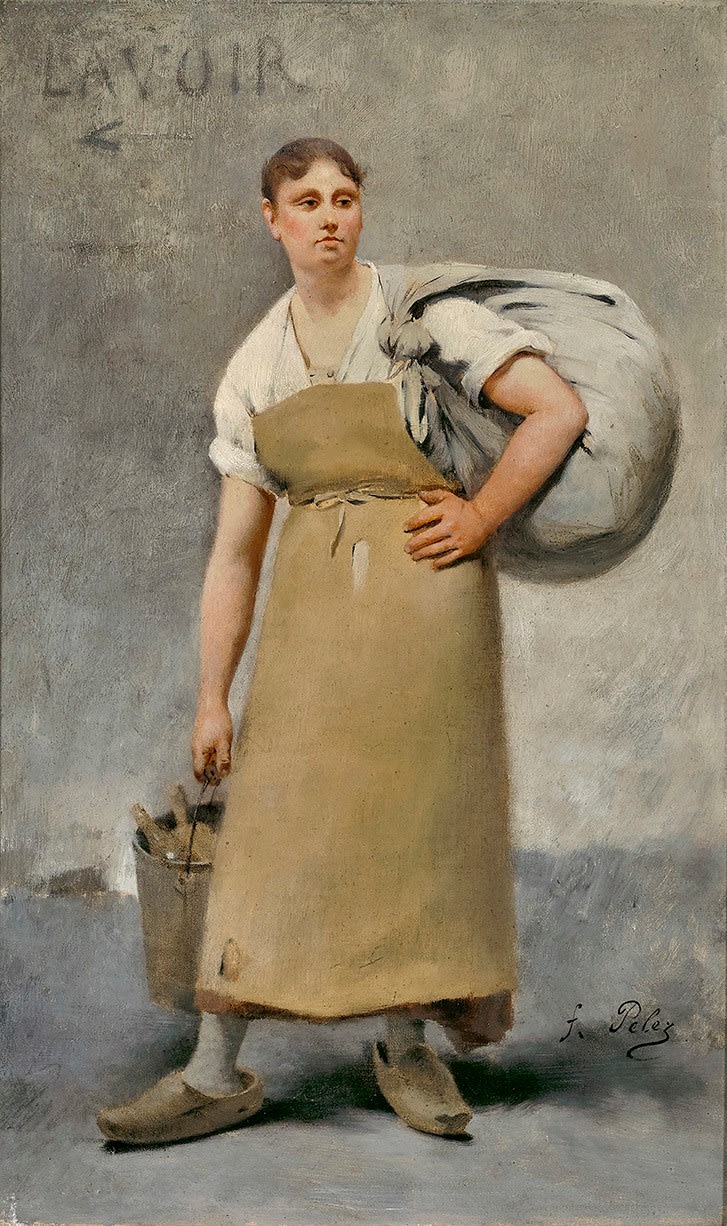
Fernand Pelez
LA LAVANDIÈRE, ca. 1880
oil on panel
16 1/8 by 9 5/8 in.
41 by 24.4 cm.
41 by 24.4 cm.
Pelez’s artistic career coincided with the era of technical advances, economic development and artistic growth known as La Belle Époque. In line with contemporary writer Émile Zola, Pelez did not highlight the beauties and successes of the period, but rather strove to show its social realities and challenges in a naturalistic way. Painter of poverty and the outcasts, after 1880, he more particularly focused his attention on the elderly, the children and women, including laundresses. Lavandières or washerwomen were a common place in 19th century society. They also became a popular subject in the Salons from 1865 to the end of the century. One such example is another painting by Pelez, Au Lavoir (At the public washhouse) currently in the collection of the Musée Malraux, Le Havre. Exhibited at the 1880 Salon, where it was acquired by the French State, this work obtained a first-class medal. The painting in hand is a simpler and more intimate scene with a single figure featuring the same model as in Au Lavoir, which would suggest that Lavandière dates from about 1880. Pelez’s interpretation of laundresses differs from the most common representations of washer women at the time, as in Emile Zola’s L’Assommoir (The Dram Shop, 1877), in which ravages of alcohol and moral degradation led to financial ruin and depravity, or as described by Octave Uzanne in 1894: “[laundresses] are clean, coquettish, and often pretty... it cannot be said that their souls are as immaculate as the linen they iron. These girls have a shocking reputation for folly and grossness.... They haunt the outskirts of the city, are inveterate dancers, descend sometimes to the lowest forms of prostitution, and are also given to drink.” (O. Uzanne, The Modern Parisienne, London, 1894, pp. 71-72). In Pelez’s painting, the statuesque washerwoman is depicted robust and hardworking,accompanied with a single word in graffiti style: LAVOIR (public washhouse) followed by an arrow underneath pointing to the direction of the washhouse. Pelez’s representation of this laundress is infused with nostalgia and a sense of well-being, while adhering to the academic principle of a graceful figure posing with her hand on the left hip, rather than a straining yet more realistic posture. Pelez also emphasizes on the lavandière’s hard work and dignity, despite her ripped clothes, the weight of the linen bag leaning on her left shoulder, and that of her washing bats in the basket in her right hand.