Gustave Doré
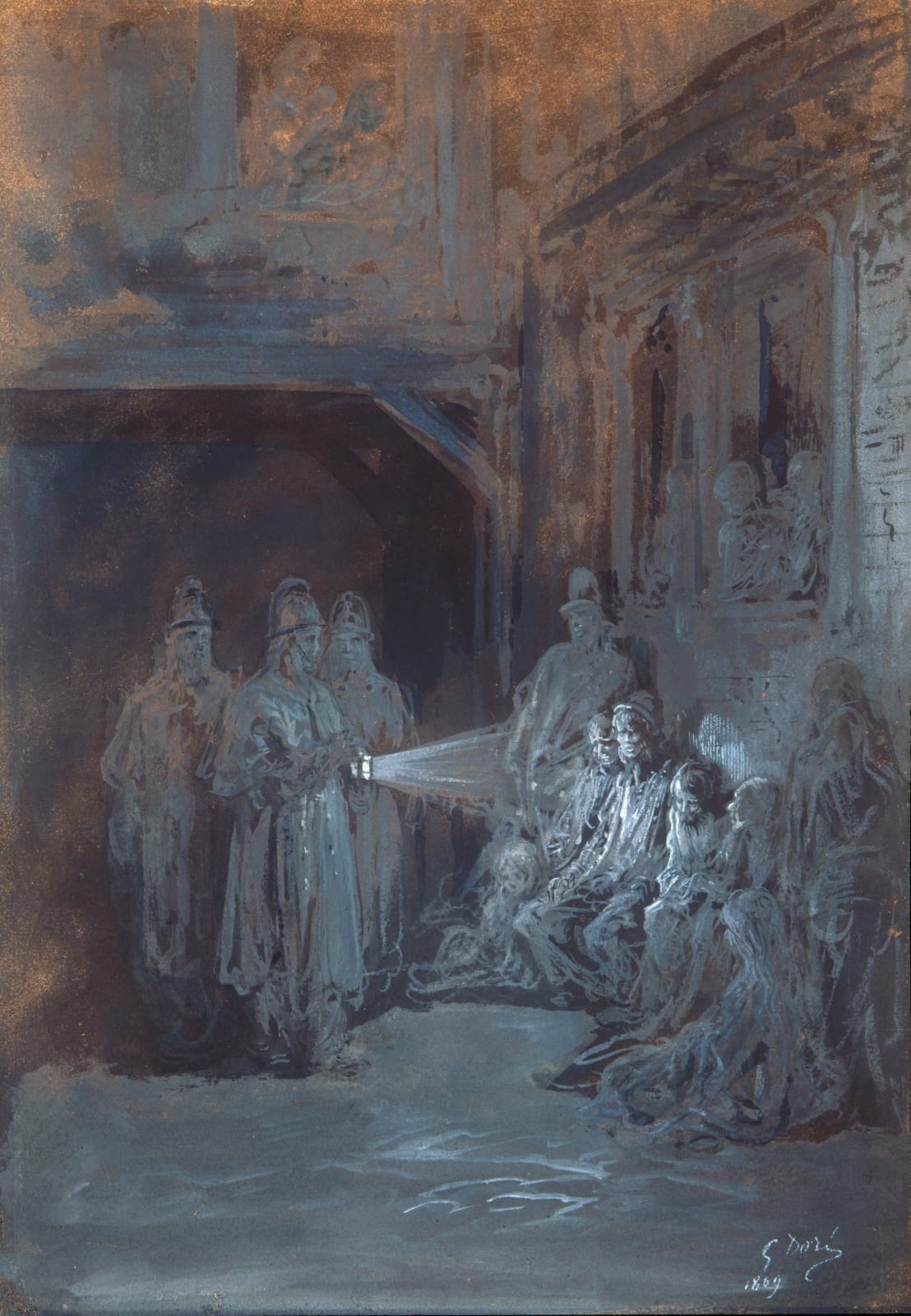
STUDY FOR THE BULL'S EYE
watercolor, brown and grey washes, heightened with white gouache
13 1/8 by 9 1/8 in.
33.3 by 23.3 cm.
33.3 by 23.3 cm.
"It was a real pleasure to watch Doré, dressed in some ragamuffin style, hurrying in and out of the streets and alleys and rapidly taking notes with the rarest precision, which served him for the composition of his blocks. I filled in the backgrounds, houses or monuments, which he afterwards animated with his glowing fanciful pencil."
—M. Bourdelin (cited in Blanche Roosevelt, Life and Reminiscences
of Gustave Doré, New York: Cassell & Co., 1885, p. 369)
This watercolor is a study for The Bull’s Eye, one of Gustave Doré’s 180 engravings that illustrate the 1872 book London: A Pilgrimage. Begun in 1869 when journalist Blanchard Jerrold (1826-1884) joined forces with Doré, the volume was conceived as an illustrated record of the shadows and sunlight of the English capital through the lens of a French-English cultural dialogue, the interpretation of the English people and architecture by a Frenchman. For Doré, who must have already been familiar with London, a city widely known for its futuristic urban planning, its density and very contrasting social realities, this book was an opportunity to immerse himself in the British capital and explore its paraded wealth in the West End and motley misery in the East, particularly in the area of Whitechapel, near the docks. As Jerrold later recalled, they spent many days and nights exploring the most dangerous parts of Whitechapel, often protected by plain-clothes policemen. Visits included shelters, gambling houses, cheap lodging houses and the opium den described by Charles Dickens in The Mystery of Edwin Drood. They also visited throughout the West End, attending fashionable events at Lambeth Palace, boat races and the derby, for example. The ambitious project, which was delayed by the outbreak of the Franco-Prussian War and then the Commune, required of Doré another trip to London and more relentless sketching nights, as the artist explained: “From the first gleam of Aurora until the moon sinks to rest I am in cabs, beating round the cardinal points of this great city.” While walking around the streets of London, Doré would take rapid notes and make rough sketches to back up his incomparable visual memory, only to execute large gouache washes such as the work at hand upon returning to his hotel room. It is probable that these fine finished washes in folio format were intended to be presented to potential publishers.
In this book and watercolor, Doré’s modern vision of London lies somewhere between the portraits and genre scenes of polite society as exemplified by James Tissot and the contemplative landscapes of Claude Monet, who spent time in London during the Franco-Prussian War. The Bull’s Eye epitomizes Doré’s technique for capturing life in the dangerous neighborhood of Whitechapel. It shows three uniformed bobbies, or members of the Metropolitan Police Force, using a lantern to illuminate a crowded scene in a slum alley. Heightened with white gouache to create a halo, the exposed yet imperturbable group is revealed in the beam of the bull’s eye, chins down, awaiting their fate. This passive attitude contrasts with that of the protagonist in the center, who in full light is watching the observer, perhaps Doré himself, hoping for salvation.
The Bull’s Eye appeared opposite page 144 in the section devoted to Whitechapel. Jerrold describes the following in a passage from the same section:
"From low house to low house we go, picking some fresh scrap of the history of poverty and crime—they must go hand in hand hereabouts at every turn … Women old and young, girls and boys in the most woful [sic] tatters; rogues of all descriptions; brazen-faced lads dancing in the flaring ball-rooms on the first floor of the public houses … wanted gin-nothing but gin. We turned into one of the lowest of low lodging houses for direction: A bull’s eye was turned upon the landlady: she was shamefaced … Rebuked by the police, who did their spiriting very gently always, they would fall back and grimace at us and imitate our manners, our voice, our movements. We were to them as strange and as amusing as Chinamen."
—London: A Pilgrimage, p. 144
Bibliography
Jerrold Blanchard and Gustave Doré, London: A Pilgrimage, London: Grant & Co., 1872.
John Coolidge, Gustave Doré’s London, Peterborough, N.H.,1994.
Michel Jouve, ‘’Le Pèlerinage à Londres de Gustave Doré,’’ Gazette des beaux-arts, 6th period, vol. 97, January 1981, pp. 41-48.
Blanche Roosevelt, Life and Reminiscences of Gustave Doré, New York, 1885.
Provenance
The artist’s collection, ParisOne of the works sent to New York circa 1895 for the prospective Doré Gallery project, which never came to fruition, and where it remained until the pictures were dispersed by the Manhattan Storage and Warehouse Company on 28th October 1947 in order to pay for their storage charges.
Seligmann Galleries, New York (circa 1946 until 1948 as Ronde de nuit, inv. no. 7697)
Everett Raymond Kinstler, New York,until 1990 (acquired from the aboveby 1948)
Jane Roberts Fine Arts Ltd., London (acquired from the above, 1990)
Piccadilly Gallery, London
Godfrey Pilkington, London
Thence by descentto the present owner
Exhibitions